| Brand Name: | LHTi |
| Model Number: | Titanium Eqiupment |
| MOQ: | 100 pieces |
| Price: | negotiable |
| Payment Terms: | L/C,D/A,D/P,T/T,Western Union,MoneyGram |
| Supply Ability: | 5000 Pieces Per Month |
Titanium Grade 1 is commercially pure titanium (CP-Ti) with 99.5% titanium. It has minimal alloying elements and provides excellent resistance to corrosion, especially in mild corrosive environments.
Grade 2 is also commercially pure titanium but with slightly more iron content (up to 0.3%), which enhances its strength over Gr1 while retaining good corrosion resistance.
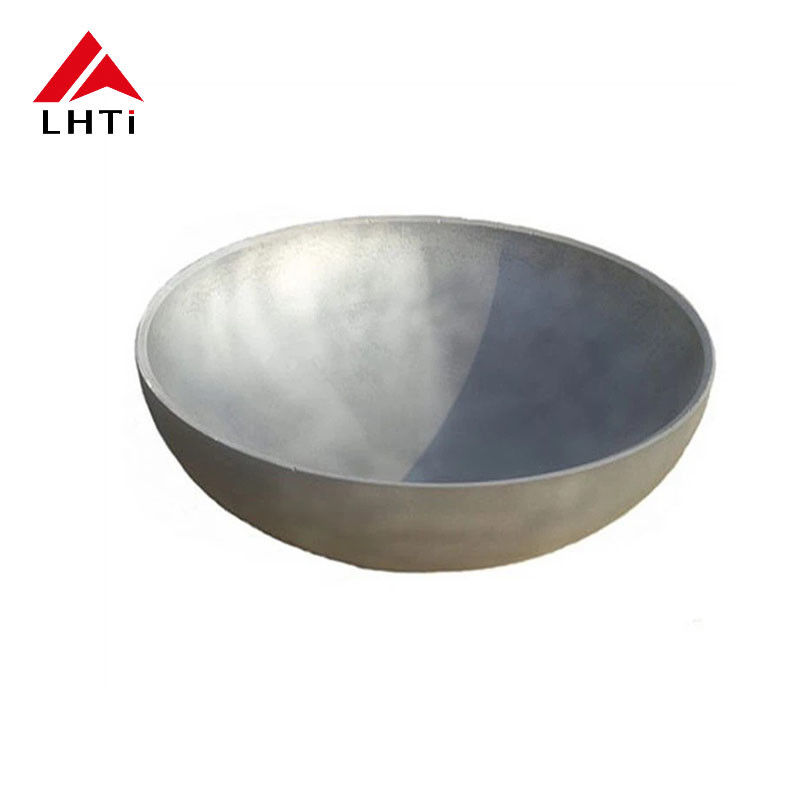
A dish-shaped hemispherical head is one of the most common types of pressure vessel heads. The hemispherical shape is ideal for pressure applications due to its structural efficiency in distributing pressure uniformly across the surface. Titanium is particularly well-suited for these applications due to its high strength-to-weight ratio and corrosion resistance.
| Product Name | Titanium dish heads /Titanium Elliptical Heads, Titanium Spherical Heads |
|---|---|
| Standard | According to ASME VIII-I Standard or DIN28013 |
| Grade | Titanium GR1, GR2, GR7, GR12, etc. |
| Size | OD300-1250mm, Or customized by customers' requests |
| Thickness | As customers' requets |
| Processing | Cold forming and hot forming |
| Inspection | 100% Ultrasonic Test and PT test after forming. (As per requirement.) |
| Surface | Pickled, Sand-blasting |
| MOQ | 3PCS |
Titanium hemispherical heads are typically produced using processes like deep drawing, hot forming, or pressing. The general process includes:
| Grade | Fe max (wt%) | O max (wt%) | N max (wt%) | C max (wt%) | H max (wt%) | Pd (wt%) | Al (wt%) | V (wt%) | Mo (wt%) | Ni (wt%) | Elong'n (%) | Rp 0.2 (MPa) | Rm (MPa) |
|---|---|---|---|---|---|---|---|---|---|---|---|---|---|
| Grade 1 | 0.2 | 0.18 | 0.03 | 0.1 | 0.015 | 24 | 170-310 | 240 | |||||
| Grade 2 | 0.3 | 0.25 | 0.03 | 0.1 | 0.015 | 20 | 275-450 | 345-480 | |||||
| Grade 3 | 0.25 | 0.3 | 0.05 | 0.1 | 0.015 | 18 | 360-480 | 480-700 | |||||
| Grade 4 | 0.5 | 0.4 | 0.05 | 0.1 | 0.015 | 15 | 500-530 | 600-680 | |||||
| Grade 5 | 0.4 | 0.2 | 0.05 | 0.1 | 0.015 | 5.5-6.7 | 10 | 800-1100 | 890-1400 | ||||
| Grade 7 | 0.3 | 0.25 | 0.03 | 0.1 | 0.015 | 0.12-0.25 | 20 | 275-450** | 345 | ||||
| Grade 9 | 0.25 | 0.15 | 0.02 | 0.05 | 0.015 | 2.5-3.05 | 15 | 550 | 650 | ||||
| Grade 11 | 0.2 | 0.18 | 0.03 | 0.1 | 0.015 | 0.12-0.25 | 24 | 170-310** | 240 | ||||
| Grade 12 | 0.3 | 0.25 | 0.03 | 0.1 | 0.015 | 0.3 | 0.8 | 25 | 414-460 | 499-600 |
Titanium alloys, particularly Grade 1 and Grade 2, are known for their superior corrosion resistance, which is crucial in chemical and marine environments.
Titanium offers a high strength-to-weight ratio, meaning that the heads can withstand high internal pressures without adding significant weight, which is important in industries like aerospace and marine.
Due to titanium's excellent resistance to corrosion, hemispherical heads made from this material have a long service life with minimal maintenance.
Titanium Grade 5, in particular, is suitable for high-temperature applications, ensuring structural integrity in extreme heat environments.
Grade 1 and Grade 2 titanium are biocompatible, making them ideal for applications in medical equipment, such as implants and surgical instruments.
Used in industries such as petrochemical, pharmaceuticals, and food processing where internal pressure needs to be safely contained.
Titanium heads are used in heat exchangers due to their resistance to corrosion and ability to withstand high thermal loads.
Used in storage tanks that require excellent resistance to corrosion from chemicals or acids.
The strength and lightweight properties of titanium make it ideal for aerospace applications, including in fuel tanks and pressurized components.
Ideal for seawater contact, where titanium's resistance to chloride-induced corrosion is crucial.
Used in the construction of reactors and other high-pressure, high-temperature components in the power generation industry.