| Brand Name: | LHTi |
| Model Number: | LH-Ring |
| MOQ: | 1 piece |
| Price: | USD25.00-150.00 per kg |
| Payment Terms: | L/C,D/P,T/T,Western Union,paypal |
| Supply Ability: | 5 tons per month |
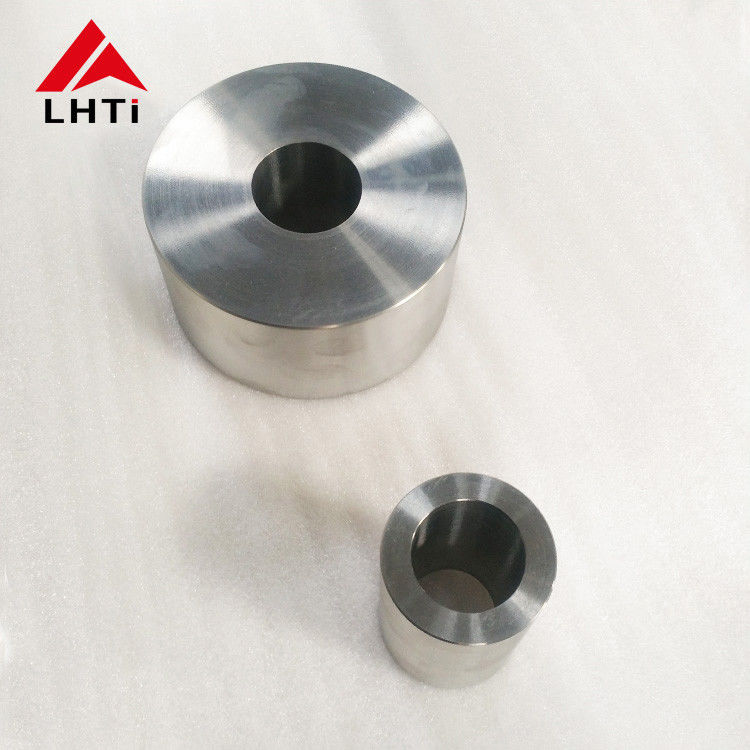
Titanium Forged Rings and Blocks to ASTM B381
A ring, a disc and a block can be the same grade, the same heat and the same certificate, and still behave differently in service, because the forging process decides which direction the grain runs. A ring rolled from a pierced billet has a continuous circumferential flow that resists hoop stress. A block open die forged between flat dies has flow along the reduction direction and little across it. Buying one shape to do the job of another is the most common mistake in forged titanium, and it does not show up on a mill certificate.
Three Shapes, Three Processes
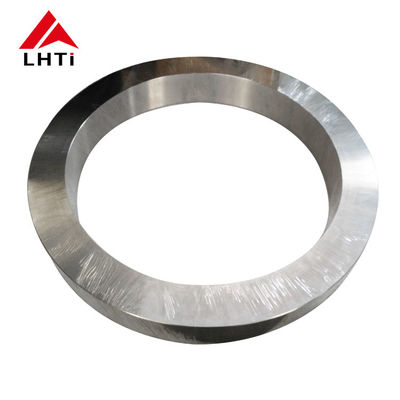
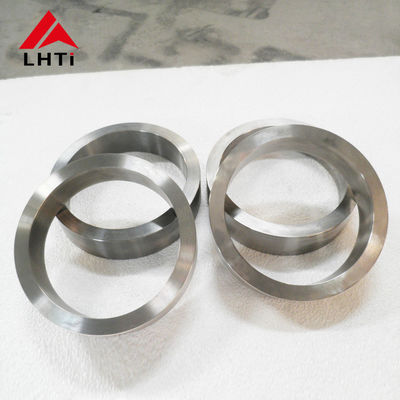
A seamless rolled ring starts as a pierced billet that is expanded between a driven roll and a mandrel. The metal is worked around the circumference, the grain follows the hoop, and the result is a part with no weld and with properties that are strongest in the direction a flange or a race actually loads it. Rings can be rolled to a close profile, which cuts machining and cuts the amount of expensive metal turned into swarf.
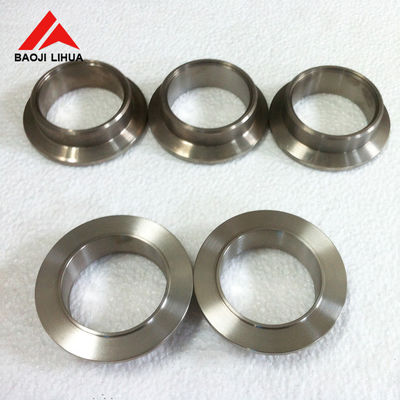
A disc is upset forged, so the billet is compressed along its axis and the grain flows radially outward from the centre. That suits a blind flange or a tube sheet, where the load is carried across the face. A block is forged between flat dies and takes the flow of the reduction, which suits a part that will be machined into a plate or a mounting block. A ring cut from plate has no hoop flow at all, and for a pressure part that is a compromise rather than an equivalent.
| Form | How it is made | Grain flow | Where it fits |
|---|---|---|---|
| Seamless rolled ring | Pierced, then rolled between a mandrel and a driver roll | Circumferential, continuous around the hoop | Flanges, bearing races, valve bodies |
| Disc | Upset forged from a billet, then trimmed | Radial from the centre outward | Blind flanges, tube sheets, covers |
| Block | Open die forged between flat dies | Aligned with the reduction direction | Machined plates, mounting blocks, test blanks |
| Ring from plate | Cut and rolled or machined from a plate | Interrupted at the cut, no hoop flow | Low stress work only, not pressure duty |
What ASTM B381 Covers
ASTM B381 is the standard for titanium alloy forgings, and it sets the tensile requirements per grade, the heat treatment condition and the tests that go with the lot. The table on this page reproduces those minimum values, and they are worth reading as minimums rather than as typicals: a Grade 5 forging at 895 MPa tensile and 828 MPa yield is at the floor of the requirement, not at the middle of the scatter.
A forging certificate should show the grade, the heat number, the heat treatment, the tensile and yield results, the elongation and reduction of area, and the test direction. The direction matters: a forging is anisotropic, and a test piece cut across the flow will read lower than one cut along it. If the part is designed on the longitudinal figures and the test piece is transverse, the apparent failure is a test artefact, not a bad forging.
| Grade on ASTM B381 | Tensile, minimum | Yield, minimum | Elongation, where it fits |
|---|---|---|---|
| Grade 1 | 240 MPa | 138 MPa | 24 percent, softest, chemical and cryogenic work |
| Grade 2 | 345 MPa | 275 MPa | 20 percent, the general purpose forging grade |
| Grade 5 | 895 MPa | 828 MPa | 10 percent, strength with a ductility trade |
| Grade 7 | 345 MPa | 275 MPa | 20 percent, palladium bearing, reducing acids |
| Grade 12 | 438 MPa | 345 MPa | 18 percent, molybdenum and nickel bearing |
Grain Flow and the Direction of the Stress
The practical consequence of forging is that the properties are directional, so the design should put the highest stress along the flow. A ring loaded in hoop has its best properties where it needs them. A lug machined out of a block with the load across the flow has the worst. This is why forged parts are usually specified with a drawing that shows the grain direction, and why a change of supplier, even at the same grade and the same standard, can change the fatigue life of a part that looks identical.
For a part that will be machined all over, the forging flow also decides how much distortion appears after the cuts. A block forged with a heavy reduction carries residual stress that is balanced inside the metal; remove one face and the balance changes, so the part moves. Stress relief before finish machining, or a symmetrical machining sequence, is cheaper than scrapping a part at the last operation.
Machining Allowance and Near Net Shape
A forging is bought oversize so that the finished part can be cut out of it. The allowance has to cover the scale, the decarburised or contaminated skin, the distortion from heat treatment and the clamping and set-up error of the machine. On a ring rolled close to profile the allowance can be a few millimetres; on an open die block it is often five to ten millimetres a side, and on a large part that allowance is a real fraction of the metal you pay for.
The allowance is also where a cheap quote hides. A supplier who offers a thin allowance has either a better process or a part that will clean up undersize, and the difference shows at the first cut. Agree the allowance on the drawing, agree who carries the risk if the part does not clean up, and ask for the as forged dimensions with the certificate rather than discovering them in the machine shop.
Ultrasonic Testing and Internal Soundness
A forging is bought partly for what is inside it, and that is what an ultrasonic test reports. The common specification for titanium forgings calls for a scan with a flat bottom hole reference, at a stated size and a stated coverage, and the result is a report rather than a promise. Porosity, inclusions, laps and bursts are the defects the test is looking for, and a forging that has been properly worked should return a clean scan at a sensible reference size.
Ask for the test report with the certificate if the part is a pressure boundary, a rotating part or a fatigue critical component. A dimensional check and a tensile test will not find an internal lap, and the cost of the scan is small against the cost of a failure in service. On a ring that will be machined to a thin section, the scan should be done after forging and before machining, while there is still metal to remove if something is found.
Supply and What to Write on the Order
The supply terms for this range are straightforward: ISO9001:2015 certification, a factory with CNC, milling and drilling capacity for finish machining, and a minimum order quantity that is quoted per item rather than published. Delivery is by express for small quantities, and the lead time for a forged ring depends on whether the size is a standard one or a new die.
Write the order as a forging specification: grade and condition, the standard, the shape and the grain direction, the as forged dimensions with the machining allowance, the heat treatment, the ultrasonic test reference and coverage, the tensile test direction, and the certificate. Add the finished part drawing if the forging is to be machined, because the allowance and the grain direction both depend on the shape of the finished part and not on the size of the billet.
Product Images
![]()