| Brand Name: | LHTi |
| Model Number: | Titanium Tube |
| MOQ: | 100 pieces |
| Price: | negotiable |
| Payment Terms: | L/C,D/A,D/P,T/T,Western Union |
| Supply Ability: | 100-200 Ton/Tons Per Month |
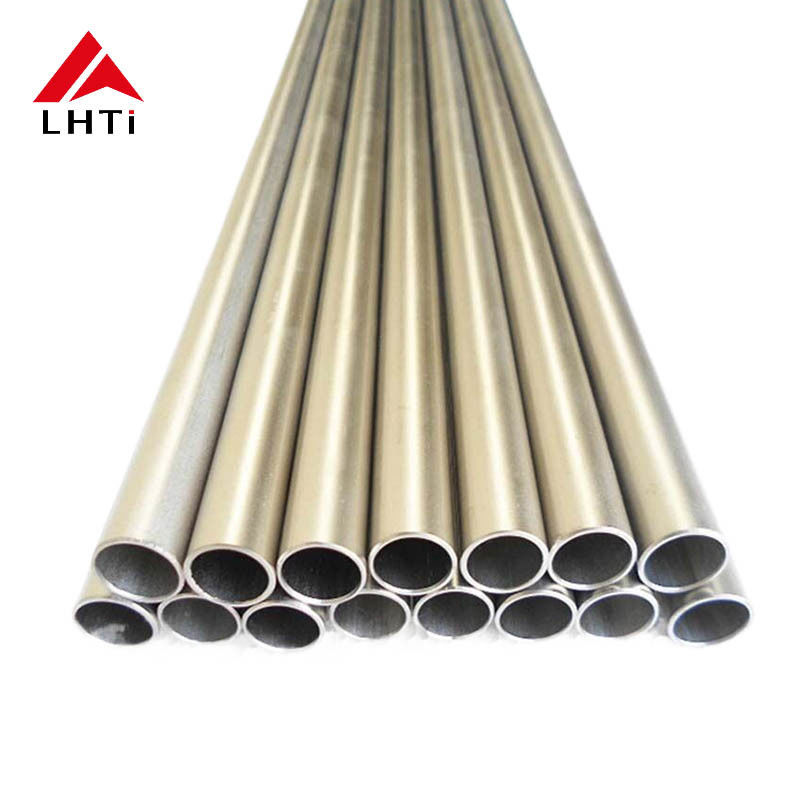
19mm Gr2 Titanium Tube for Heat Exchanger Bundle
Nineteen millimetre outside diameter is the most common tube size in shell and tube heat exchangers, and most of the problems that shorten a bundle life start at two places: the wall, and the joint where the tube meets the tubesheet. This tube is seamless titanium in Grade 2 or Grade 5 to ASTM B338, supplied annealed and tested, ready for rolling or welding into a bundle.
Why 19 mm Works in a Bundle
A 19 mm tube gives a large heat transfer surface for a given shell volume while keeping the flow velocity in a sensible band. Smaller tubes pack more area but raise pressure drop and foul faster; larger tubes need a bigger shell for the same duty. With a 0.7 mm to 1.0 mm wall the tube stays light, which matters because a bundle of several thousand tubes is lifted and slid into the shell as one piece, and every kilogram is multiplied by the tube count.
Tube Data
| Outside Diameter | 5 mm to 114 mm, 19 mm standard for exchangers |
| Wall Thickness | 0.3 mm to 10 mm |
| Length | Up to 12 000 mm, cut to bundle length |
| Grades | Gr1, Gr2, Gr5, Gr7, Gr12 |
| Standards | ASTM B338, ASTM B337, ASTM B861 |
| Condition | Annealed, pickled or bright |
| Testing | Eddy current, hydrostatic, flattening, air underwater |
| Tolerance | Wall and diameter to ASTM B338 table |
| Certificate | EN 10204 3.1 with heat number |
Wall Thickness and Heat Transfer
Titanium conducts heat at roughly 21 W/mK, about a quarter of copper, so the wall is kept thin to hold the overall coefficient up. Thin wall lowers resistance but leaves less metal for corrosion allowance and for the grip of a rolled joint. On seawater duties a 0.7 mm wall on 19 mm tube is typical, with 1.0 mm or more where the shell side is dirty or the tube is rolled rather than seal welded. Grade 5 allows a thinner wall for the same pressure, which recovers some of the thermal penalty of the alloy.
The Tube to Tubesheet Joint
A rolled joint relies on wall reduction: the tube is expanded into the hole until the metal yields against the groove, typically five to seven percent of the wall. Too little and the joint leaks in service; too much and the tube cracks at the transition. For critical duties the rolled joint is backed by a light seal weld, which needs a clean, oxide free surface and a dry, low humidity shop because titanium picks up oxygen and nitrogen at welding temperature.
Fouling, Cleaning and Water Chemistry
Titanium resists chlorides, so cooling water can be chlorinated without pitting the tube. The limit is velocity: above about 3 m/s in clean seawater the protective film can be eroded, particularly at the inlet ends, so ferrules or thicker inlet sections are used. Smooth bore and a passive surface also mean deposits release more easily during cleaning, which keeps the coefficient stable between outages.
Packing and Ordering
Quote by outside diameter, wall, grade, length and test package, for example 19 mm x 0.7 mm Gr2 ASTM B338 annealed, eddy current tested, 6000 mm random length. Tubes are packed in wooden cases with end protection, bundles are strapped and labelled by heat number, and test reports travel with the shipment.
Product Images
![]()
![]()