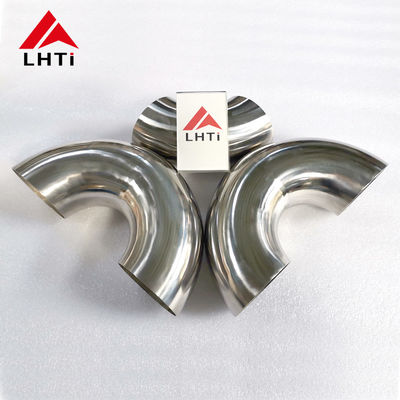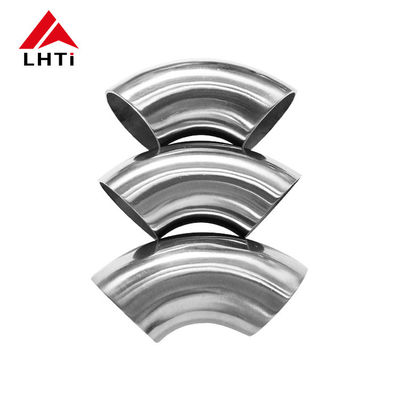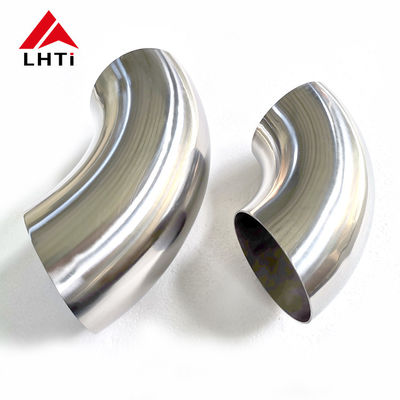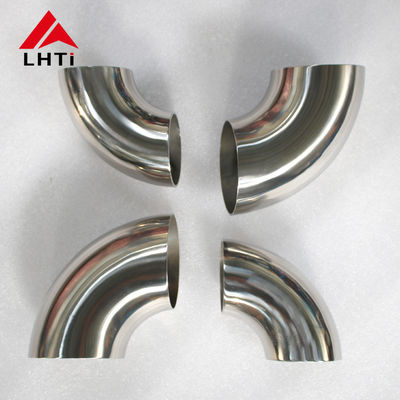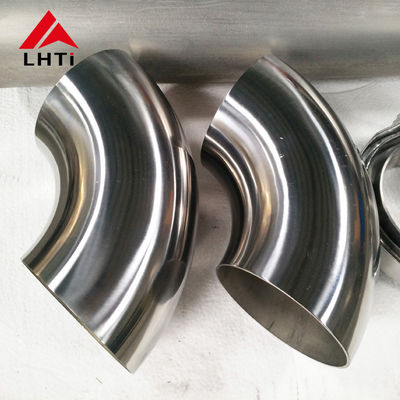
Titanium 180 Degree Return Bend to ASME B16.9
A return bend turns a line through 180 degrees in a single piece. Instead of two 90 degree elbows welded back to back, the pipe enters and leaves on parallel centrelines with one forming operation and one set of ends. That removes a weld, removes the purge joint inside the curve, and removes the point where two separate bends would have to agree about their angle. These are titanium return bends to ASME B16.9 dimensions and ASTM B363, 1.5 and 2 inch, in Gr2 and Gr5.
Return Bend Data
| Grade | Gr2 (UNS R50400) as standard, Gr5 Ti-6Al-4V on request |
| Standard | ASME B16.9 dimensions, ASTM B363 |
| Size | 1.5 inch (48.3 mm OD) and 2 inch (60.3 mm OD) |
| Angle | 180 degree return |
| Radius | Long radius, 1.5D, centre to centre 114 mm at 1.5 inch and 152 mm at 2 inch |
| Wall | Sch 10 or Sch 40, matched to the pipe |
| Ends | Bevel 37.5 degree with 1.5 mm root face, weld connection |
| Finish | Polished, or pickled and passivated |
| Inspection | Dimensional report, PMI, penetrant on request |
One Piece Where Two Welds Used To Be
The obvious saving is one circumferential weld per return, but the real gain is at the root. A weld inside a curve is the hardest joint in a thin wall titanium line to purge, because the gas has to travel round the bend and the operator cannot see the back of the root. A one piece return removes that joint entirely, so the only welds are the two straight ends, both of which can be reached with a torch and a trailing shield.
Centre to Centre Is the Dimension That Matters
For a 180 degree return the controlling dimension is not the leg length but the distance between the two parallel centrelines. Both ends are cut to that centre to centre figure, and an error there cannot be corrected by trimming a leg, because trimming changes where the curve starts rather than the offset. The dimension is held to plus or minus 1.5 mm, and on a multi-pass heater coil it is checked against a template before the piece is released.
Where Return Bends Are Used
The common applications all need a compact reversal. Fired heater and convection section coils serpentine back and forth with returns at the end of each pass. Tank heating coils and steam spargers turn 180 degrees inside a vessel where a pair of elbows would not fit. Exhaust crossovers and silencer inlets use returns to bring the gas back to the opposite side of the engine bay. In each case the parallel leg spacing, not the angle, is what the surrounding steelwork was designed around.
Polished or Pickled
Polished returns are specified where the bore has to stay clean, because a smooth wall holds less scale and gives the cleaning fluid nowhere to sit. Pickled returns are the choice for chemical duty, where a uniform passive film matters more than roughness, and for any component that will be welded on site, since a polished surface next to the joint has to be re-protected anyway. External polish is usually cosmetic, for visible exhaust work.
Welding Both Ends
A return has two joints that must close at the same time. Tack both ends with the piece free, check the centre to centre dimension and the parallelism of the two pipe runs, then weld in a sequence that alternates from one end to the other so the shrinkage of the first joint does not pull the second out of alignment. Purge through the piece with oxygen under 50 ppm, and keep the purge in until the last pass has cooled below 400 degrees Celsius.
Ordering and Certification
Quote by outside diameter, wall, radius, angle, end type and finish, for example 2 inch OD, 3.91 mm wall, long radius 180 degree return, bevel ends, polished. Each piece is supplied with a certificate to EN 10204 3.1 that carries the heat number, the chemistry and the mechanical results, and the marking on the fitting matches the certificate so the trace stays intact through fabrication.