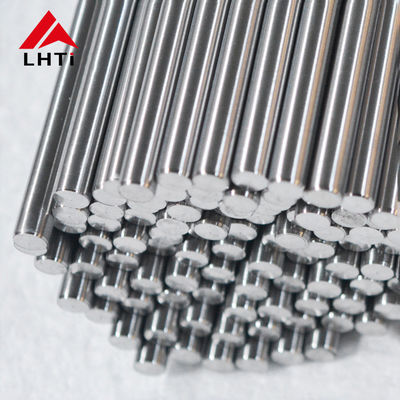
| Brand Name: | LHTi |
| Model Number: | Titanium Rod |
| MOQ: | 30 kg |
| Price: | $20.00~$30.00/kg |
| Payment Terms: | T/T,,L/C,Western Union,Paypal |
| Supply Ability: | 300000 kg per month |
18 mm Gr5 Titanium Bar: Weight, Tolerance and Machining
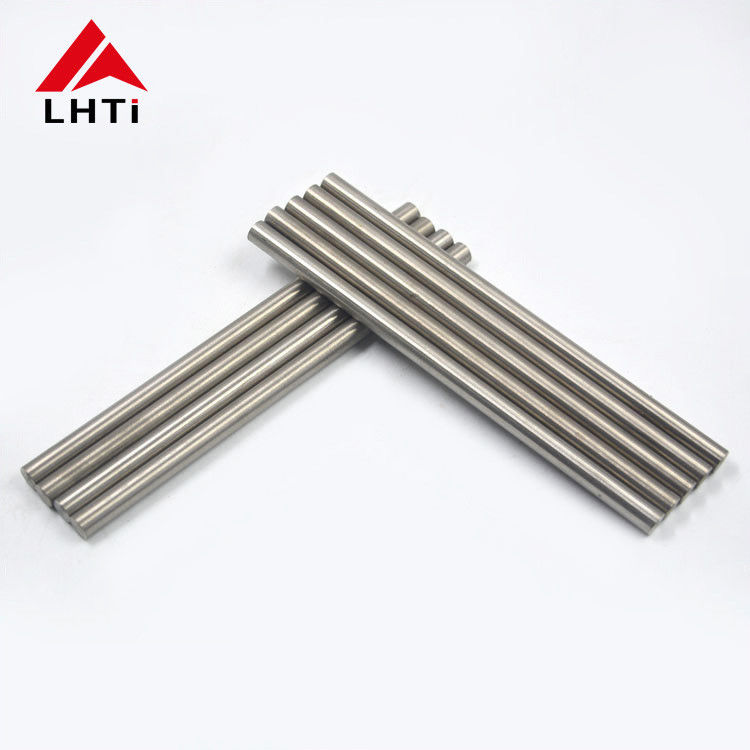
Eighteen millimetres is a convenient size for a titanium alloy bar: heavy enough to hold a thread and a shoulder, light enough to handle by hand, and large enough that a machined part can be cut from it without a long lead time on stock. This page sets out what an 18 mm Gr5 bar weighs, how much tolerance to expect, and how the alloy behaves under the tool.
What Gr5 Means at This Size
Gr5 is Ti-6Al-4V, the workhorse alloy. The chemical table on this page gives 5.5 to 6.75 percent aluminium, 3.5 to 4.5 percent vanadium and oxygen to 0.20 percent, with a minimum tensile of 895 MPa, a minimum yield of 828 MPa and 10 percent elongation. Density is 4.43 g/cm3, not the 4.51 quoted elsewhere on the page, because the aluminium in the alloy lightens it slightly. Any weight calculation for Gr5 should use 4.43.
Weight per Metre and per Bar
An 18 mm round bar has a section of 254.5 square millimetres. At 4.43 g/cm3 that gives 1.13 kg per metre, so a six metre bar weighs 6.76 kg. The same bar in steel would weigh 2.00 kg per metre, which is where the handling advantage of titanium comes from, and also why a titanium bar can look expensive per kilogram and still be competitive per finished part.
| Diameter | Section mm2 | Weight kg/m | Weight per 6 m | Same bar in steel |
|---|---|---|---|---|
| 12 mm | 113.1 | 0.50 | 3.01 kg | 0.89 kg/m |
| 16 mm | 201.1 | 0.89 | 5.34 kg | 1.58 kg/m |
| 18 mm | 254.5 | 1.13 | 6.76 kg | 2.00 kg/m |
| 20 mm | 314.2 | 1.39 | 8.35 kg | 2.47 kg/m |
| 25 mm | 490.9 | 2.17 | 13.05 kg | 3.85 kg/m |
| 30 mm | 706.9 | 3.13 | 18.79 kg | 5.55 kg/m |
The weight column matters for more than handling. It sets the payload of a machining centre pallet, the capacity of a saw, and the freight cost of a shipment quoted in kilograms. On an 18 mm bar the section is small enough that a bar feeder can run it, which is not true at 60 mm, and that is often the hidden reason a part is designed around this size.
Tolerance and Straightness
An 18 mm bar is normally supplied turned, polished or pickled. Turned bar holds around plus or minus 0.1 mm on diameter, polished and ground bar can hold h9, which for 18 mm is zero to minus 0.043 mm, and h11 is zero to minus 0.11 mm. A drawing that asks for h9 without saying whether the surface is ground is asking for a tolerance the process may not deliver.
Straightness is quoted separately and is often the property that decides whether a bar will feed. Around one millimetre per metre is normal for commercial bar; a bar that has to pass through a spindle liner needs better, and should be ordered as straight, cut to length and chamfered. Ends that are sawn square and deburred save more time at the machine than they cost at the mill.
Annealed, or Solution Treated and Aged
The condition attribute on this page is annealed, and that is the right default for machining. Annealed Gr5 at 895 MPa tensile machines predictably. Solution treating and ageing raises tensile strength towards 1100 MPa and yield towards 1000 MPa, which is where the 1000 MPa figures that appear on titanium pages come from. A stronger bar is also a less forgiving bar: it galls faster, it work hardens faster, and it needs more rigidity in the setup.
Which Standard Applies
For an 18 mm Gr5 bar, ASTM B348 is the primary document and AMS 4928 is available on request for aerospace buyers. F136 and F67 are implant standards, and of the two only F136 applies, and only when the alloy is the ELI version certified as grade 23. A certificate that offers F136 against standard Gr5 is a mismatch worth querying.
| Standard | Applies to an 18 mm Gr5 bar | What it fixes | Typical buyer | Limitation |
|---|---|---|---|---|
| ASTM B348 | Yes, primary document | Chemistry, tensile, tolerances | General industry | Commercial tolerances only |
| AMS 4928 | Yes, on request | Aerospace bar and forging stock | Aerospace | Adds mill and test duties |
| ASTM F136 | Only for ELI, grade 23 | Implant grade Ti-6Al-4V ELI | Medical | Not for standard Gr5 |
| ASTM F67 | No | CP titanium for implants | Medical | Unalloyed grades only |
| ISO 5832-3 | On request | Surgical Ti-6Al-4V wrought | Medical | Separate certification |
Machining Notes
Titanium alloy cuts with a sharp tool, a modest surface speed and a heavy feed that stays under the work hardened skin. It galls against carbide and against stainless, so a tool that has cut stainless should not go straight into titanium without a clean. Coolant has to reach the edge in volume, because the low thermal conductivity of the alloy keeps heat in the cut rather than letting it leave with the chip.
Ordering Notes
State the standard, the grade and whether ELI is required, the diameter with its tolerance class and surface, the length and end finish, the condition, and the test package. A 3.1 certificate with chemistry, tensile results and the heat number is normal, and a PMI check on delivery closes the loop between what was ordered and what arrived.
The attribute block on this page still describes the material as pure titanium and the density as 4.51. For an 18 mm Gr5 bar both entries are template defaults rather than facts about this product: Gr5 is an alloy, and its density is 4.43. The chemistry and tensile tables further down are the reliable data, and the order should follow those.
Product Images
![]()
![]()