| Brand Name: | LH-Ti |
| Model Number: | LH-BL |
| MOQ: | 1 piece |
| Price: | US dollar $30/pc--US dollar $80/pc |
| Payment Terms: | L/C,T/T,Western Union |
| Supply Ability: | 5000 pcs per month |
Gr1 and Gr2 Titanium Flanges: TA Grades Explained
Two naming systems meet on a titanium flange order. The ASTM grades Gr1 and Gr2 are what most international drawings and certificates use, while Chinese mills, including this one, also work to the GB/T TA marks. The two systems describe the same metals under different names, and a purchase order that mixes them without saying which one governs is a common source of delay at goods inwards.
TA0 to TC4: What the Chinese Marks Mean
The GB/T titanium system uses TA for near pure grades, TB for beta alloys and TC for the alpha beta alloys. TA0 and TA1 sit at the low oxygen end and match ASTM Gr1. TA2 is the standard industrial purity grade and matches Gr2. TA3 matches Gr3. TA9 is the palladium modified grade and matches Gr7, and TA10 is the molybdenum nickel grade and matches Gr12. TC4 is Ti-6Al-4V and matches Gr5.
| Chinese mark | ASTM grade | Alloying addition | Tensile / yield, MPa | Flange note |
|---|---|---|---|---|
| TA0, TA1 | Gr1 | None, lowest oxygen | 240 / 138 | Low pressure only, soft face |
| TA2 | Gr2 | None, standard oxygen | 345 / 275 | The default flange grade |
| TA3 | Gr3 | None, higher oxygen | 485 / 380 | Rare in flanges, harder face |
| TA9 | Gr7 | Palladium 0.12 to 0.25 | 345 / 275 | Chlorides and reducing acids |
| TA10 | Gr12 | Mo 0.2 to 0.4, Ni 0.6 to 0.9 | 438 / 345 | Hot acid, not for chlorides |
| TC4 | Gr5 | Al 5.5 to 6.75, V 3.5 to 4.5 | 895 / 828 | High load, harder to forge |
The mapping is close but not a licence to substitute freely. A certificate is normally issued to one system, so the order should name the system that the receiving inspection will check against. If the drawing says TA2 and the report says Gr2, the inspector needs a written equivalence on file, or the material will sit in quarantine while somebody confirms it.
Choosing Between Gr1 and Gr2 for a Flange
The difference between Gr1 and Gr2 is oxygen, not alloying: about 0.18 percent against 0.25 percent. That lifts the tensile from 240 to 345 MPa and the yield from 138 to 275 MPa, and it is the reason Gr2 is the default for a flange. A bolted joint loads the face in compression around the gasket, and a soft Gr1 face at large diameter will deform under bolt preload before the gasket has seated.
Gr1 still has a place. It is the more formable of the two, it is easier to bend and it takes a deeper gasket groove impression at low bolt load, which suits low pressure water and utility lines. What it does not suit is a Class 900 or 1500 joint where the bolt load is high and the face has to stay flat through several make ups.
Chemical Service Decides More Than Strength
The application field on this page says chemical industry, and in that service the grade is chosen by the medium rather than by the strength. Gr2 is the general purpose answer for oxidising acids and for neutral solutions. Gr7 is the answer where chlorides are present, because the palladium addition lets the metal repassivate instead of pitting. Gr12 is the answer for reducing acids and hot solutions, where the molybdenum and nickel do the work that palladium cannot.
| Service | Use | Avoid | Why | Report to ask for |
|---|---|---|---|---|
| Seawater, brine | Gr2 or Gr7 | Gr12 | Chloride pitting and crevice attack | Grade plus heat number |
| Wet chlorine | Gr7 | Gr2, Gr12 | Palladium shifts the corrosion potential | Gr7 chemistry line |
| Nitric acid | Gr1, Gr2 | Gr7 for cost only | Oxidising acid suits CP titanium | Interstitial limits |
| Reducing acid | Gr12 | Gr2, Gr7 under free acid | Mo and Ni raise resistance | Mo and Ni values |
| Hypochlorite | Gr7 | Gr2 at high temperature | Crevice attack under gaskets | Gr7 plus face finish |
Two of those choices are frequently reversed in practice. Gr12 is often offered as a general upgrade over Gr2, but it is weaker than Gr7 in chlorides and should not be used for seawater. Gr7 is often offered wherever acid appears, but its advantage disappears in strongly oxidising acid where plain Gr2 performs well at a lower price.
ANSI and ASME Are One Standard
The title of this page repeats the standard twice, once as ANSI B16.5 and once as ASME B16.5. Those are the same document: ANSI is the older name of the body that now publishes as ASME, and B16.5 has carried the ASME prefix for decades. Listing both is harmless, but it is a sign that the attribute block was written for search rather than for a drawing.
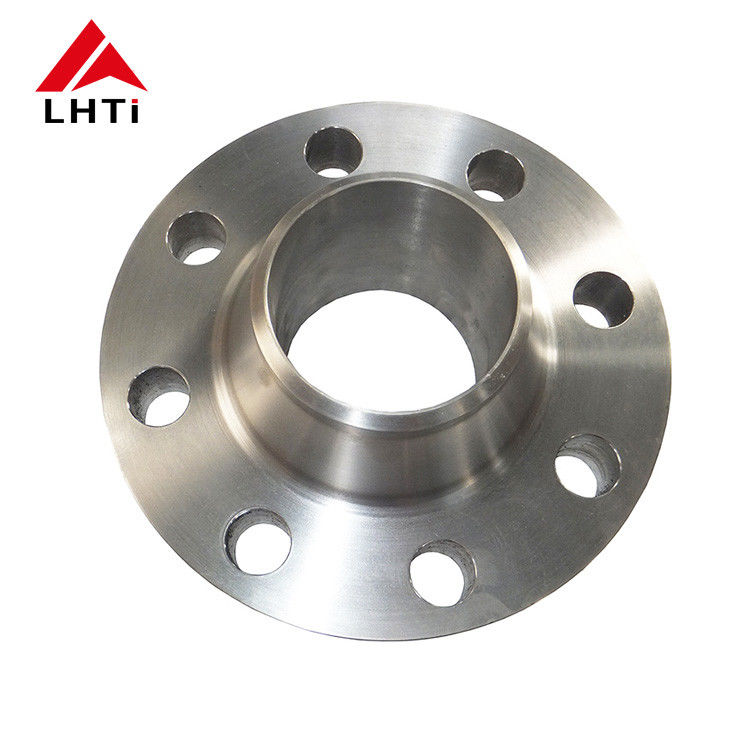
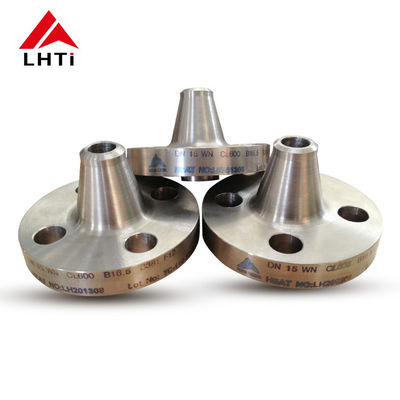
The product name field is a more serious inconsistency. It says ANSI titanium blind flange, while the page title and the description describe flanges in general. A blind flange is one specific form with no bore. If the item being quoted is a weld neck or a slip on, the field should be corrected before the offer is issued, because the type decides the price more than any other single field.
Ordering Notes
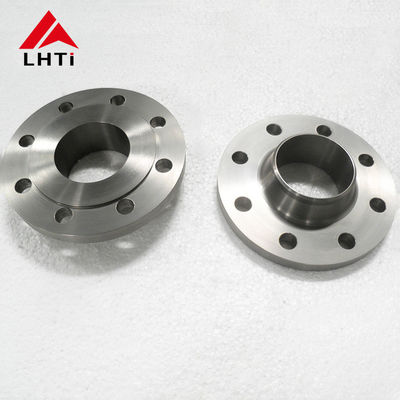
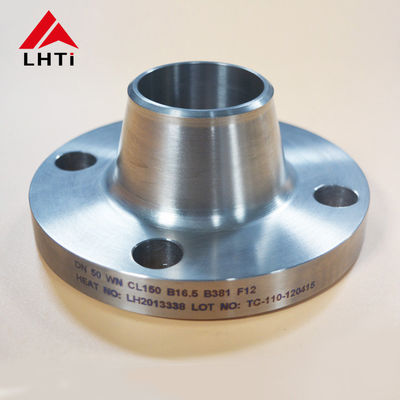
State the type, the grade in one naming system, the standard, the size, the class, the face and the report. The type is the field most often missing on enquiries that arrive from a search, and it is the first thing a works needs in order to quote: a blind, a weld neck and a slip on at the same size and class are three different castings or forgings with three different weights.
On this page the material field lists gr2, gr7 and gr12, while the title and the description lead with Gr1 and Gr2. Gr1 is therefore offered but not listed, and a buyer who needs Gr1 should say so explicitly. The technique field reads Froged, which is a spelling of forged, and the inspection field promises ultrasonic testing with a 3.1 report, which is the combination to keep on the purchase order.
Size and pressure follow the pattern of the other pages in this range: NPS 1/2 to 24 is written next to DN 10 to 2000, but NPS 24 is DN 600, so the bracketed figure overstates the range for a B16.5 flange. Class 150 to 2500 is consistent with B16.5. Quote the class, not a converted pressure in bar, because the class sets the bolt circle and the gasket as well as the wall.
Product Images
![]()